The HyperTexts
Joseph S. Salemi
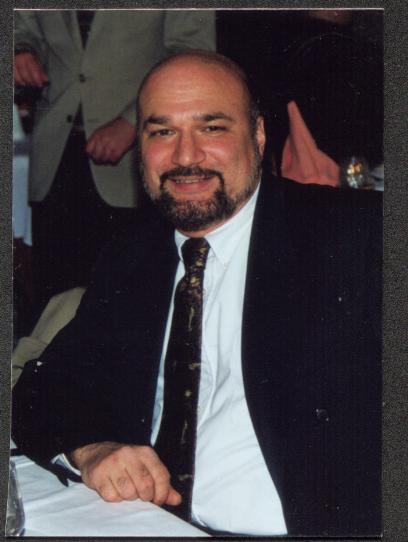
Please be advised that Dr. Salemi has a penchant for calling
other people "faggots," "feminist bitches," "liberal scum," "immigrant
scum," and the like. Salemi has also called his fellow
formalists "cowards," "careerists," "suck-ups," "poseurs" and other
derogatory terms for failing to use initial line caps in their poems and
similar trivialities. After I published my response to Salemi's emails about
our interview, he posted an article on another website in which he called me,
either directly or in thinly veiled ways, "simple-minded,"
"pathetic," a "hillbilly liberal" (presumably
because I live in Tennessee), etc. Salemi
insisted that he doesn't insult poets, then proceeded to insult me
repeatedly, thus confirming what I and other poets had previously observed. Rather than responding in kind, I will stand by what I
wrote.
— Michael R. Burch, editor, The HyperTexts
Dr.
Joseph S. Salemi is an American poet, translator and scholar who
teaches in the Department of Humanities at New York University, and in the
Classics Department of both Hunter College and Brooklyn College, C.U.N.Y.
In the following poem Dr. Salemi calls Protestants who believe the Bible to
be infallible "yahoo dorks," a "witless herd," "jerks," "fundie dopes" and
"crackpots" And yet, in a moment of confession, Salemi told me that he
believes Catholic popes are capable of speaking infallibly!
— MRB
Creationist Fanatics
It's time to wag some savage tongue
At those who think the earth is young.
“Creationists” are what they're called
And frankly, you would be appalled
At what these yahoo dorks believe:
Apparently, they can't conceive
An age beyond six thousand years
For all the planetary spheres.
According to this witless herd
The Bible's the inerrant word
Of God Himself, and you had better
Believe it right down to the letter.
He made the earth and all we see
Around four-thousand-four B.C.
In one short week of frantic bustle
(God, you know, can really hustle).
The animals, the plants, and man
Came fully formed from God's own hand
Without the help of evolution.
Jerks in thrall to this delusion
Think fossils are an evil ruse
Placed by Satan to confuse
Mankind, and foster non-belief,
Thus leading to eternal grief.
Creationists say dinosaurs
Lived with cave men, and their roars
Could be heard on Noah's Ark,
And Eden was Jurassic Park
Where T. Rex and his monstrous ilk
Walked about as mild as milk.
Brontosaurus browsed the trees
With Eve and Adam at his knees,
And our first parents washed their dishes
In streams that held pre-Cambrian fishes,
For all was made at once, they croak:
God did it at a single stroke.
As for Darwin, these folks claim
He's now awash in penal flame,
And all who take his devilish path
Will join him in that fiery bath.
It really takes your breath away
That anyone with brains could say
We can ignore the age of rocks
That serve as stratigraphic clocks,
The speed of light, and isotopes
That prove (except to fundie dopes)
The earth's age is at least four billion
Of our years, give or take some million,
Or that these crackpots can deny
That simpler life forms live and die
And give rise, after countless ages,
To changed ones in successive stages.
This shows the human mind is liable
To rot when it assumes the Bible
Is a text of literal fact.
The truth is that the Bible's packed
With legends, myths, and allegories,
Fables and fictitious stories
Composed for a didactic purpose—
One can't believe them on the surface.
These yarns were spun to pierce the skull
Of shepherds, nomads, and the dull
Mentality of unschooled peasants
For whom myth was the living presence
Of Yahweh and His sacred word.
But now, it's mulishly absurd
To not admit these tales fantastic
Are just an arcane metaphrastic
Way of preaching to the masses
Who can't see things through reason's glasses.
This potpourri of Torah-tales
Is fictional, like Jonah's whale,
Or Joshua's trumpet, or the Flood,
The Red Sea parting, Abel's blood,
Sodomites made blind and halt,
A woman turning into salt,
Hagar saved by magic water,
Jephthah chopping up his daughter,
Manna dropping from the skies,
And all those other pious lies.
The scriptures tell us how to live
But don't presume they also give
Us scientific information
About the details of creation.
The Bible's sacred text was penned
To teach us of our final end;
It only speaks symbolically
Of how existence came to be.
So if you live in regions raw
Like Tennessee or Arkansas,
Rural Georgia, Texarkana,
The fever swamps of Alabama,
Or in the stretch of Geisterwelt
That Mencken called the Bible Belt,
Or in some mental dormitory
Where preachers howl for God and Glory,
Confine yourself to prayerful moan,
And leave the scientists alone.
Copyright © 2008 by Joseph S. Salemi
The Reformation
Luther took a massive shit;
Zwingli got a whiff of it.
Then he wrote the Saxon friar
To express his righteous ire:
“I can’t stand your German turd—
I like Calvin’s Gallic merde!”
Back from Wittenberg there came
This rebuttal to the same:
“Listen, you obnoxious Swiss—
The stink is stronger when I piss.
As for spreading crap around,
Anabaptists win, hands down.”
The Missionary's Position
I maintain it all was for the best—
We hacked our way through jungle and sought out
These savage children, painted and half-dressed,
To set their minds at ease, and dispel doubt.
Concerning what? Why, God's immense design,
And how it governs all we do and see.
Before, they had no sense of the divine
Beyond the sticks and bones of sorcery.
Granted, they are more somber and subdued,
Knowing that lives are watched, and judged, and weighed.
Subject to fits of melancholy mood,
They look upon the cross, and are afraid.
What would you have me say? We preached the Word
Better endured in grief than left unheard.
The Lilacs on Good Friday
Tumult of noontide long ago dismissed—
The rent veil unremembered, and the sun
Relit, though shrouded in a new eclipse
Of rainswept sky. The garden seems to shun
That spectral agony of blood and bone;
Consigns itself instead to placid sleep
Untroubled as the moss upon a stone
And heedless while the three Marias weep.
Four decades' growth of lilac by this wall
Stretches its shallow spiral to the sky.
Clustering blossoms, soon to swell and fall,
Gather themselves like nimbuses on high
Out of my hand's grasp, yet I still can bend
The pliant osiers downward to my face,
And sniff the buds that already distend:
Late April lilacs, delicate as lace.
Unlike that rigid tree, untenanted,
And red with memory of three hours' grief,
The thornless lilacs summon up no dread,
Demand no witness. Flower, branch, and leaf
Are only what they are. They have no words
For us to ponder, though we sometimes feign
To speak for them, as augury of birds
Construes an omen of impending pain.
The book is shut, the candle snuffed, the bell
Rings the finale of a troubled day.
Did lilacs grace the garden where we fell,
Or scent Gethsemane? I bade you pray
And watch with me a little while this night—
Could you not watch one hour? The world's bereft
Of that which once gave stomach for a fight
Or certitude to vision. I have left
The Office of the Holy Cross unsung
But patient on the rubricated page:
Open my lips, O Lord, and let my tongue
Announce thy praises—in some other age.
Here in this garden how could it displease
To let the lilacs offer up my prayer—
Sweet censers that, when shaken by the breeze,
Scatter their fragrance in the evening air?
And in that garden where a sepulcher
New-hewn from rock awaits the mourners' tread,
Where cerecloths, unguent, aloes mixed with myrrh
Will soon enshroud the lacerated dead,
There is some solace from the thought of how
Late April lilacs, coming into bloom,
Shall dance the currents of the air, and bow
To shed their flowerets on an open tomb.
from Formal Complaints
La Nonna's Cracked Clay Jug
(La quartara ciaccata di la Nonna)
Dura chiù na quartara ciaccata
ca una sana.
—Sicilian proverb
Whether it cradled wine with curved caress,
Whether it travelled daily to the well,
Whether it carried oil from the press,
Or stood as empty as a whitened shell,
This clay jug served to oversee and bless
La Nonna's kitchen, and just as a bell
Sings in its circled fullness, arching round,
The jug—in silence—still makes its own sound.
Nine decades since it turned upon the wheel
La Nonna's jug assumes a static role,
And scorns, in haughty honor, to conceal
From lip to base (as if from pole to pole)
A line that zigzags downward to reveal
A cracked jug will last longer than a whole.
Dizain for the Lamia
The lamia was a fabulous beast, half woman and
half serpent, that
lured men to their deaths through sexual
temptation. The lamia
emitted a hissing sound so soothing and seductive
that men were
irresistibly drawn to her.
Go to a charnel house, and enter in—
Curled in a corner sweetly hissing lies
The lamia, a female shaped for sin,
Who writhes a serpent's tail below her thighs.
Uncoiling to meet you, she will rise;
You cannot move, transfixed by that dull hum.
Her scented breasts invite delirium;
Hope's lost in the profusion of her hair—
Those dead grey eyes say one word only: Come!
Her kiss is lethal. But you hardly care.
from Formal Complaints
Martial
I.73
Caecilianus,
There wasn't a guy in this whole damn city Who would have touched your old lady
without a stud fee
When she was easily available.
But now, with all those chaperones you've hired,
There's a pack of cocksmen waiting to bang her.
You sure are clever.
(Translated from the Latin by Joseph S. Salemi)
Bion of Smyrna
Great Cypris stood before me in a dreamy haze
Holding by her fair hand the hand of baby Desire
Whose head hung heavily downward, in an earthbound gaze.
She spoke thus to me: Herdsman, take him and inspire
My child by teaching him to sing the rural lays.
She ordered, and I foolishly began to teach
As if the child were willing to pay heed and praise
To Pan, Athena, Hermes, Phoebus—all and each
Who made the pipes and lyre, flute and the sounding harp.
In vain I taught these things to him—he laughed, and then
Brushed them aside, and sang those love songs sweet and sharp,
Of his mother’s deeds, and the hungry lusts of gods and men.
And I forgot whatever I had tried to impart,
But all that Desire sang to me, I learned by heart.
(Translated from the Greek by Joseph S. Salemi)
The Bog Man
In Bronze Age northern Europe, criminals or designated victims were ritually
drowned in swamps. Their perfectly preserved corpses (called bog men) are
sometimes found by modern peat cutters.
Twelve feet under, caked in a leafy humus,
He lay hidden, swaddled in
putrefaction,
Till the peatmen dug with their wooden turf slanes
Down to a corner
Where four thousand years ago, sinking slowly,
He descended, gulp upon gulp of
water.
Oozy silence closed like a fist about him,
Seemingly endless.
He who heard the Druid demanding blood-debt,
Felt the hempen cord and the brazen
axes,
Choked in terror when he was lifted upwards
Over the bog’s edge,
Hung suspended while sacrificial chanting
Filled the forest. Pitiless tribal
totems
Watched him swallowed up by the brackish quagmire
In expiation.
Brought to light, his face is a mask projecting
Only sleep and sadness across
the ages;
Grim exhaustion hangs on his wrinkled eyelids.
Part of his sentence,
Though unspoken, was to await this moment
And endure the prattle of foolish
voices
Asking questions, wondering—while he lies there
Helpless to answer.
Corporate Opportunity
The chance to spend life totting up
Gross income and expenses,
Forbidden to express a view
That might disturb consensus;
To turn your mind and soul-strength to
Some widget-maker’s profit;
To not just sip the hireling’s cup
But force yourself to quaff it;
To regulate your thinking by
The figures on a spread-sheet;
To dread a drooping graph worse than
A syphilitic bedsheet;
To blindly follow routines that
Top management arranges,
And while you parrot policy,
Anticipate its changes;
To bootlick for the CEO,
Sling flattery in dollops;
To summon up a toady’s smile
To please the in-house trollops;
To cringe in paralytic fear
Before a boss’s swagger;
To know your back’s a target for
The cold, collegial dagger;
To tune your speech to market trends,
Endure an ad man’s raving;
To finish every task, and then
Despite your years of slaving,
To wonder if some MBA,
To make the place efficient,
Will classify you obsolete,
Redundant, or deficient.
Going Along to Get Along
Dedicated to far too many of my contemporaries,
and they know who the hell they are.
I. I am the perfect poet—
I strike a dainty pose.
I sniff the air for floral scent
And elevate my nose.
I’m not a coarse and graceless type
Who spouts obscene derision.
Instead I generate a cloud
Of pure Platonic vision.
II. I hunger for the precious,
For sweetness and for light.
Harmony and peace and love
Are present when I write.
Emotion is the air I breathe—
I’m caught up in its fever.
My arms swing in inclusive arcs
Like some bel canto diva.
III. My scope is truly global;
My art embraces all.
I’m open-minded, liberal, and
I’m multicultur-al.
I’ll never write offensively
Or touch on taboo’d topics,
Like stuff you read in Rochester
Or Henry Miller’s Tropics.
IV. I frequent all the workshops.
I share my early drafts.
I network with like-minded friends
And suck up to the staff.
I go to every conference
To venerate my betters,
And thereby gain a foothold in
The inbred world of letters.
V. I’m also vaguely leftist—
That’s how you have to be
If you’re to be accepted in
Polite society.
And this accounts for my success
With all the folk who matter:
My letter-perfect expertise
In brainless, po-biz chatter.
Ten Spurts of Venom
by Joseph S. Salemi
Wordsworth urged poets to “recollect emotion in
tranquility.” A poet who was less of a sentimental milksop
would rephrase that to say “Dredge up an old hate, and give
it literary life.”—Derek Burgoyne
To A Blocked Writer
You claim you’re blocked, and can’t squeeze out the words?
You’re constipated, so we’re spared your turds.
To An Incompetent Violinist
A question darker than the Sphinx’s riddle:
Where the hell did you learn how to fiddle?
To A Frenchwoman
You don’t arouse me anymore, poupée—
Not since I saw you straddling a bidet.
To A Tough City Poet
You paint an urban landscape, stark and gritty—
Too bad your verse is limping, dull, and shitty.
To An Unlucky Gambler
At cards and dice and ponies you’re all wet—
So try your hand at Russian-style roulette.
To A Cougar
You know why young studs use you for a quickie?
Boys that age are never very picky.
To A Heroin Addict
You live a life of bliss, devoid of pain,
As long as you can find a working vein.
To
A Lecherous Minister
To godliness our urges should aspire,
But yours don’t rise above the female choir.
To An Overweight Hottie
You used to get guys energized and hard—
But that’s before you put on all that lard.
To A Bureaucrat
You say we must obey rules and respect ‘em—
We say you need a switchblade up the rectum.
The Televangelists
If you’re lookin’ for salvation
Prove it with a big donation.
Down in hell there’s souls a-writhin’
’Cause they didn’t do their tithin’.
Remember what is owed to Caesar—
Amex, Mastercard, and Visa
Will work fine, but cash is dandy,
Or your checkbook, if it’s handy.
Christ expelled the shekel-changers
Claimin’ they were total strangers
To the house of prayer—but honey,
Tabernacles run on money.
Send your hallelujahs over
To the throne of High Jehovah
Decked out in His lordly raiment—
He takes prayers, but we take payment.
The Bones of the Armenians
Son of man, can these bones live?
—Ezekiel, 37:3
Not the trump of Gabriel, nor the tumult
Stirred up by a clamorous resurrection
Can awaken bones from that desert nightmare's
Prodigal torment.
Not the prayers from myriad begging voices,
Solemn penance chanted by dirging fathers
In atonement's chorus of expiation
Cleanses the blood-guilt.
Neither screaming pleas of a gang-raped mother,
Nor the pistol shots to the heads of children
Rouse them out of somnolence. Nothing serves to
Summon avengers.
Just the dumb remembrance and silent breathing
Of those few survivors who still can picture
1915's Golgotha, red with murder,
Waiting for answers.
Published in First Things
In One Ear
In the Strand I picked up a little
profligate wretch and gave her sixpence.
James Boswell, London Journal,
4 June 1763
Boswell listened, Johnson talked.
Then the Scotsman went and walked
London's alleyways and mews
Seeking trollops from the stews.
All that weighty, sage advice
From the Doctor, without price,
Never made the slightest dent
On a youth whose natural bent
Drew him towards the rankest sluts—
Brains were trumped by churning guts.
Such are humans. At the best
We may listen, be impressed,
Marvel at sagacious wit—
Then go act as we see fit.
Mind and will stay far apart;
Reason does not touch the heart;
Impulse shatters logic's chain;
Argument goes down the drain.
Aristotle's books slam shut
When we are in heat or rut.
Published in The Formalist
Calligraphy Lesson from a Chinese Student
She took my hand and showed me how to coax
The inkstone gently, to release black swirls
Into a well of water. Soon smooth strokes
Of badger brush—held upright—laid out twirls
And streaks of meaning. "Here I make the sign
For teacher," she said, smiling as she drew
A character, precise in every line,
And glistening with fresh wetness. I said, "You
Are now the teacher, and I am a student."
She made me no reply, but then extended
The brush in offering, as though impudent
Forwardness on her part had offended.
I laughed, refused, and urged her to go on
She smiled again, the chill of distance gone.
Charity's Gift
When Jesus therefore saw His mother and the
disciple standing by whom He loved, He said
unto His mother: Woman behold thy son! Then
said He to the disciple: Behold thy mother! And
from that hour the disciple took her into his own
home.
—John 19: 26-27
Pinioned here, I look downwards to see
My mother weeping in unfettered grief
Her heart transfixed by swords, beholding Me
Hang from this branch like autumn's final leaf.
Disciple John—how much more than the rest
My soul smiles on him in completest love!
Mother and friend, by misery oppressed,
Huddle and hunch together. Raised above
This scene of bleeding spirits, I can make
No sign of recognition or concern
Except to speak out from My wooden stake
And give them to each other, for I yearn
To show the world how caritas unties
The bond of blood and flesh, and doing so,
Entwines a new knot even as it dies.
I bid you, mater dolorosa, go
And seek Me in the lambs that I hold dear:
The captives ransomed by My bitter cup—
For through this gift I make love's mandate clear:
Go wash each other's wounds, and bind them up.
Published in First Things
Poetry Today
Since Baudelaire and Verlaine, the field has shrunk:
Mere feelings, hokum, moral cant, and whining.
In greater ages, poetry was drunk
On Bacchic dance, blood lust, occult divining,
The savagery of Swift, the wit of Byron,
Poe's death-wish, Dowson's pedophilic viols;
The obscene lisping of a sluttish siren
Formed Wilde and Swinburne's Dionysian styles.
No tawdry brothels now, nor spired cathedrals:
Just thatched mud huts for lemmings to call home—
Epiphanies of small, pathetic people
As pallid as a cracked and sunbleached bone.
Today verse wears the regulation dress
Of inoffensive bourgeois politesse.
A Martian in Michigan Sends a Message Home
American folk are the dutiful sort
Who never would nurture a renegade thought.
Their minds move about in some well-travelled ruts;
They think with their glands and their gonads and guts.
They cannot see reason; they cannot make sense—
They're sure disagreement just proves you are dense.
They only know how to exhort and to preach
And pass regulations to govern your speech.
They gossip, drive cars, and consume franks and beans,
And haven't a clue as to what it all means.
Published in The Formalist
An Academy Painter Judges the Impressionists
Impressionists? Their palettes are ablaze
With upstart colors heretofore unseen.
The lack of expert drafting makes for haze
And blurring in their polychromic scheme:
Puce, lemon, antique rose, and tangerine;
Cinnabar shading into umber hints;
Streaks of a velvet peridotal green
Speckled with azure flecks and ruby tints.
Sienna strokes are stabbed with yellow glints
Of golden fire, while a violet hue
Bleeds into ochre patches; orange sprints
In flashes across lilac and soft blue.
Not unexpected—once you banish line
Color runs riot like an unpruned vine.
Published in The Formalist
Two New Sections from A Gallery of Ethopaths
with illustrations by Bob Fisk
New Formalism is dying from decorum. I don't mean "decorum" in its correct rhetorical sense,
which refers to the proper allocation of tone and diction to subject matter. I mean the kind
of social decorum that is expected at a cocktail party in the Harvard Club. For some strange
reason many poets who have championed the revival of metrics seem to think that
a corollary to their task is a revival of the Victorian mindset, with all its
quaint notions of propriety, decency, and schoolmarmish reticence. As a result a great deal of
contemporary formalist poetry is anemically bland. Very little sex, and no salty
language.
A partial explanation of this phenomenon lies in a larger American social problem—namely, the unspoken and unholy alliance of the prudish
Religious Right and the prissy Feminist Left.
Like the Hitler-Stalin Pact, this marriage of convenience is one that
left-liberals would prefer to forget.
But the alliance is real, and it is effective.
And it has had significant consequences for American linguistic habits,
at least in the public sphere.
Our Midwestern Bible-thumpers hate salty language for
religious reasons, and will quote you scriptural passages ad nauseam on
the subject. If you actually look at
those passages, however, you will see that they are about swearing, cursing, and
taking the Lord's name in vain, and not about using what are politely called
"four-letter words." To swear is to
take an oath; to curse is to call down evil on something; and to take God's name
in vain is to utter it disrespectfully or in a context that lacks reverence.
But salty language? There
isn't anything in the Bible that says you can't make generous use of George
Carlin's infamous seven vocables.
In the case of feminists, their objection to robust
language has to do with a visceral rejection of anything that smells of male
boisterousness or insensitivity, and is more a function of their white middle
class status anxiety than anything political. Feminists are the true neo-Victorians in our society, a coterie of
unpleasant little Orwellians who would dearly love to censor speech in the same
way that they have wrecked pronoun usage. And together with their nominal enemies on the Religious Right, they are
working assiduously to geld and denature public discourse in the United States.
In Book XXIV of the Iliad, the goddess Thetis advises her
son Achilleus to forget his troubles by having casual sex.
She says "It's good to lie in lovemaking with a woman."
A more up-to-date translation might be "It's great to get laid."
Would that sort of Homeric honesty fly in our overly decorous New
Formalism? Probably not, if the
Bible-thumpers and the feminists have anything to say about it.
The following two unpublished sections of A Gallery of
Ethopaths are presented here, along with illustrations by the superb
political cartoonist Bob Fisk, as a symbolic counterweight to this
mésalliance of homegrown American crackpots.
We cannot allow discourse, whether poetic or forensic or political, to be
strangled by fanatics. Do you think
otherwise? Then visit one of those
hideous Third World tyrannies where the
politicians will make you spend every waking hour thinking about what you can
and cannot say.
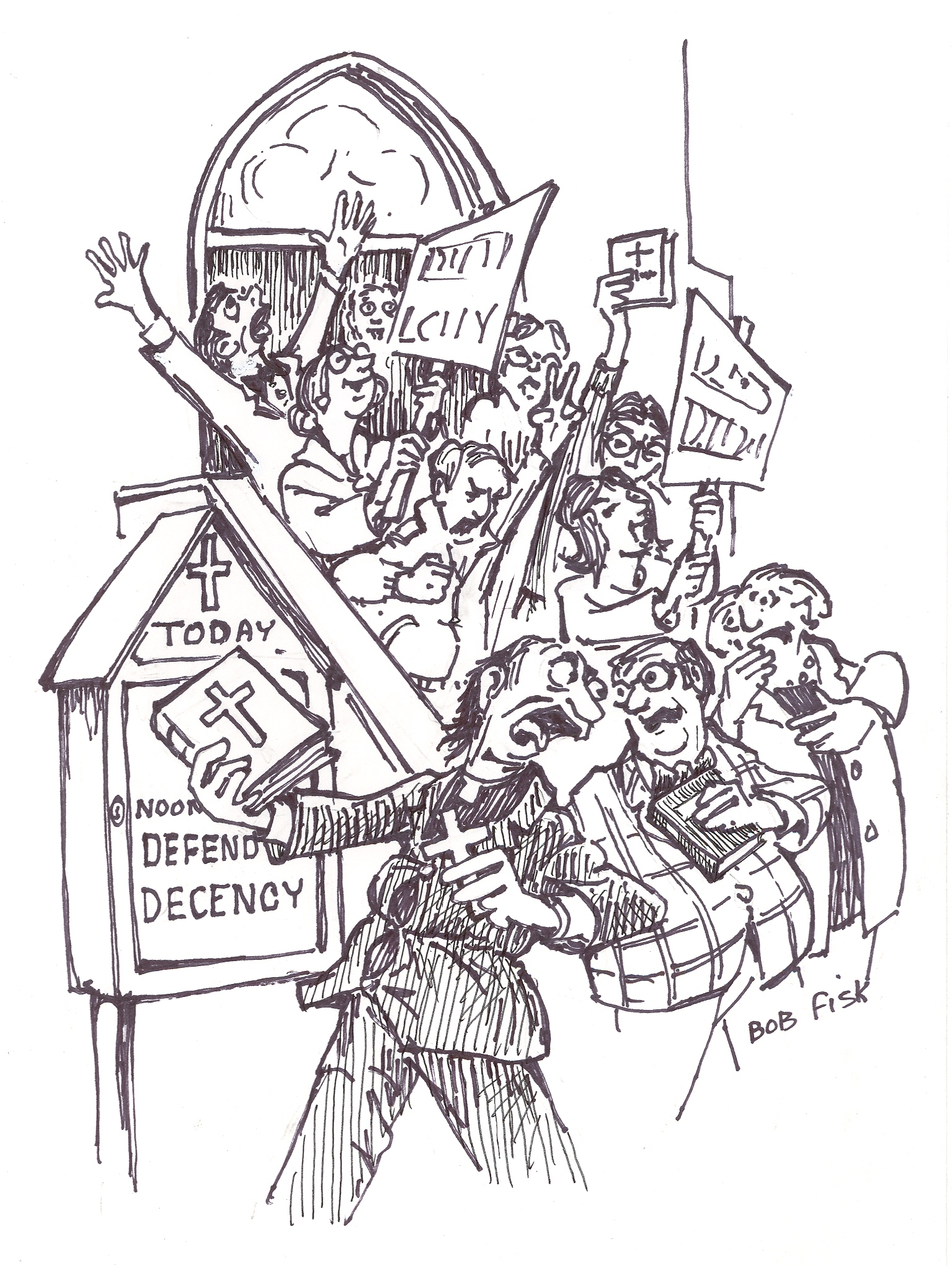
Clean-Language Freaks
A boring sort of ethopath
Is one who's seized by livid wrath
If you use "bad words" in his hearing.
He gets upset if talk goes veering
In a raw, obscene direction—
He'll hit you with a stern correction,
And say that you must watch your tongue
And not throw vile words in among
The purer vocables of language.
His warning has an adder's fang's edge,
And I have not the slightest doubt
If you don't stop he'll punch you out.
You mostly find these prim-lipped clowns
In stupid little one-horse towns,
Or hamlets where some Baptist howler
Makes Sunday mornings even fouler
Telling folks how to dress and think.
There is a pretty solid link
Between the fans of Nice Clean Speech
And tendencies to gas and preach.
These puling, milksop moral lambs
Can't stand the sound of hells and damns,
And if you say a word like shit
They'll go into a holy fit
And blow their little moral stacks
And lambaste you with thumps and whacks.
Don't dare to utter cunt or prick—
They'll have your liver on a stick.
They even grab their birchen rod
If someone simply mentions God
(They think He should be called "The Lord"
In tones that are quite overawed.)
They cannot even be enticed
To say the name of Jesus Christ
Except when muttering a prayer
In rapturous devotion's air.
These prissy, squeamish, tight-assed nerds
Who can't abide four-letter words
Are lacking in the basic grit
That makes a man a mensch. A bit
Of blue-toned language spices life
And keeps one sharpened, like a knife
Ready to slash and cut and stab
Some dull opponent's mental flab.
Plain language tells all gutless types
That you have got the balls and tripes
To say whatever you are thinking
While they are tied in knots and shrinking
From honest and forthright expression.
Their pallid speech is a confession
That they lack spunk and inner drive,
And hence their words are not alive.
Vapid twits who do not swear
Give off a tweedy, pious air
Like otherworldly English vicars
Who pass out at the sight of knickers.
But as for one who's not averse
To belching out a raw-boned curse,
The arsenal of human speech
Is well within his grasp and reach.
His tongue's a well-honed bayonet
Kept in its scabbard, safe, and yet
Quick to be bared when danger nears—
Liars and fools and sloganeers
Are terrorized by his tongue's bite,
Its stinging lash, its will to smite.
Copyright © 2008 by Joseph S. Salemi
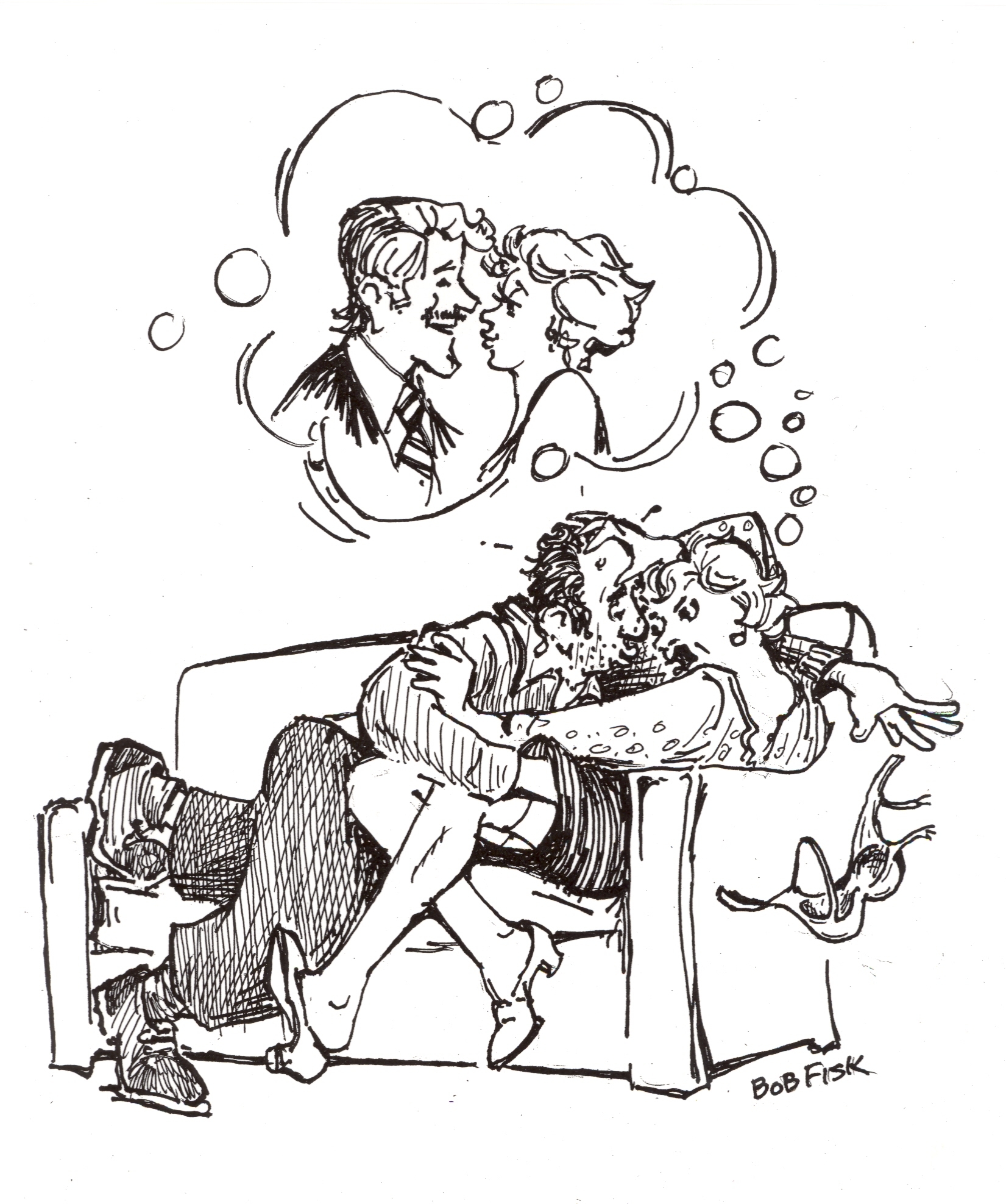
The Dating Service
The modern world does not take chances—
We even regulate romances.
We don't trust Cupid's random dart
To pierce us with its burning smart.
Instead we ask a bunch of experts
To smooth our path to lively sex. Skirts
Aren't chased the way they once were.
Indeed, you'd be a total dunce, sir,
To use that antiquated means
For getting in a lady's jeans.
The process is no longer sleazy—
The businessmen have made it easy.
They've turned dating to a science.
A smoothly running new appliance
Couldn't function any better
To find a girl and help you get her.
Here's the way the system works
To guarantee your carnal perks.
Once past thirty, girls get nervous—
They sign up in a dating service
That promises to locate men
Who'll call them every now and then.
The girls hope that the men will wed them;
Most guys merely want to bed them.
They do one girl, and find a newer;
The average man's a serial screwer.
That's the basic situation:
Male lust, female desperation.
A girl is hungry for a beau—
The dating service knows it's so.
They charge the chick a hefty sum
And pair her with a jerk, a crumb,
A psychopath, a nerd, a cretin
Who then expects some heaving pettin'
On the first night that he meets her.
He doesn't even spring for pizza!
He's vile, disgusting, smelly, dull,
And brainless as a hollow skull.
His breath's atrocious, and his talk
Is raucous, like a mallard's squawk.
He rips her blouse and runs her hose,
And spatters semen on her clothes.
The girl's enraged, but still determined—
She tries again, and yet more vermin
Show up at her door unshaven,
Pock-marked, horny, or plain ravin'.
She tries once more. This time it's you
With suit and tie, and flowers too.
You escort her around the town.
You don't act like a selfish clown.
You treat her well, you buy her dinner—
In her eyes, you're a hands-down winner!
Suddenly the skids are greased—
Romantic chances are increased.
When girls meet a halfway decent
Guy, they think of their most recent
Date with some obnoxious boor.
And here you are—polite, mature,
Friendly, funny, sweet, unsweaty.
At that point, to Jane or Betty
You're a godsend and a blessing.
Pretty soon you're freely messing
With her hair, her cheek, her ear
And unhooking her brassiere.
The dating service triumphs nicely!
She gets what she wants precisely:
A man who's not a loathsome geek
With scabrous skin and body reek,
And you get free, untroubled mating
Without the cross of prolonged waiting.
A brilliant ploy for every fellow!
This service is a cheap bordello
That sets you up with some cute honey
And doesn't cost you tons of money.
Capitalism has it planned:
Let supply control demand.
Copyright © 2008 by Joseph S. Salemi
Two New Sections from A Gallery of Ethopaths
with illustrations by Bob Fisk
I recently had a long exchange of e-mails with Michael
Burch, the webmaster of this site, on various religious and aesthetic issues.
Concerning some things, after exhaustive debate, Mike and I agreed to
disagree. But we had no difficulty at all
in jointly asserting that most poets today are wimps and conformists.
[Please allow me to interject that I certainly do agree with Joe that American poets
should exercise our hard-won freedoms of speech and dissent. As many
readers of The HyperTexts know, I have challenged poets to give us
their best poems on controversial subjects, as our
Heresy Hearsay
page attests. But I tend to be more optimistic about human nature than Joe, and
my method is to challenge rather than berate poets. Joe's choices of words here
are his own, not mine. I don't believe that "most poets today are wimps and
conformists." That's what Joe believes. What I believe is that American poets
should (and will) follow in the tradition of heretics and truthtellers like
Blake, Shelley and Whitman, speaking boldly and forthrightly: the sooner, the
better. —Michael R. Burch, Editor, The HyperTexts]
I don't know why this should be so.
There isn't a thin dime to be made off poetry, unless you count the
piddling little prizes that are offered here and there.
Absolutely nothing is riding on what we write, so why shouldn't we
express our viewpoints as freely and as openly as we wish?
The film critic John Simon once pointed out that when an art form ceases
to bring a commercial return, it is then liberated, and can proceed to develop
its highest aesthetic potential. Well,
poets have never made money, so why in hell should they be as timorous as
untenured assistant professors? We are
free to say whatever we please in whatever manner we choose.
But we don't. A tremendous
opportunity for aesthetic achievement is being ignored.
Consider the insufferable nerdiness of so many modern
poets: their pusillanimous ordinariness and vacuity and lack of interesting
character. Driven by a pathetic need to
be liked by as many people as possible, these types are always on their best
behavior. It's this overanxious,
parent-pleasing conformism that I find the most offputting
characteristic of contemporary poets.
Go to any public reading and you'll see what I mean: the hesitation, the
tentativeness, the barely audible voices, the self-deprecating humor, the
suppressed fear, the hypersensitivity to audience reaction … all this makes me
wonder if I'm listening to human beings or to androids.
Are there exceptions?
Sure. But the exceptions are
increasingly exceptional. Poets—like
everyone else in this over-regulated and security-camera-scanned world—are
learning to toe the line of what is acceptable and not acceptable.
Those who don't are quietly sidelined and ignored.
And a great many of our self-appointed neo-Victorians think that this
situation is right and proper.“Poetry is
becoming responsible,” one of them sniffed at a forum recently.
It wasn't always this way.
Think of the long string of past poets who lived what can only be called
irregular lives, and who dissented audibly from the received opinions of their
times. Villon was a thief and a
scapegrace. Marlowe was a blasphemer and
an atheist. Ben Jonson was a murderer, Rochester a pornographer,
Byron a rake. Blake's attitude towards
the God of the Old Testament was one of contempt and loathing, and he was
arrested once for political subversion.
Poe was an alcoholic, Swinburne a sadomasochist and pagan sensualist, Dowson a
hashish-smoker and a would-be pedophile.
Rimbaud dealt in gun-running and slave-trading.
Even Shakespeare, who is often held up as a model of bourgeois propriety,
led a racy private life in London while leaving his boring family in Stratford to their own devices.
The list could go on and on.
Could poets do stuff like that today?
Sure, but at a price. Your legal
fees, you alimony, and your medical bills would be overwhelming.
It's much easier to teach in some little community college dungheap, run
workshops, and scrounge for grant money.
Your poetic life can revolve around faculty meetings, conferences, and the
occasional coed groupie. It's a lot safer
than gun-running and pedophilia.
Think of the trouble Baudelaire had when he published
Les Fleurs du Mal. Conventional and
bien-pensant French opinion was outraged.
Would anyone risk that today?
Aeneas Silvius, the Renaissance savant who later became Pope Pius II, wrote a
hysterically funny and bawdy Latin verse drama about prostitution.
(It's called Chrysis—look it up).
What poet with any hopes for a higher position would dare do that now?
The great Ovid took flak from the Emperor Augustus for his racier books
like Amores and Ars Amatoria, and he was eventually exiled to Tomi
for “indiscretions.”The closest thing to
that today is Amiri Baraka getting canned by the State of New Jersey.
Wimp poets write wimpish poetry.
And that is what strikes me as particularly troublesome in a great deal
of modern poetry. Poets are
unwilling to say anything really provocative and potentially trouble-making.
They won't address an issue that might cause controversy.
Instead, what you get is a totally bogus courage that manifests itself in
the writing of poems against the war, against oppression, against racism, or
against any other conveniently safe target that helps you make a fashion
statement about your own enlightened liberalism.
That's about as daring and courageous as combing your hair.
Here are two sections of A Gallery of Ethopaths that
actually go after real targets: the Protestant fundamentalist proponents of
Creationism, and the stupid out-of-towners who come to infest Manhattan.
They are accompanied by the illustrations of Bob Fisk.
Will these poems make enemies? I sure hope so.
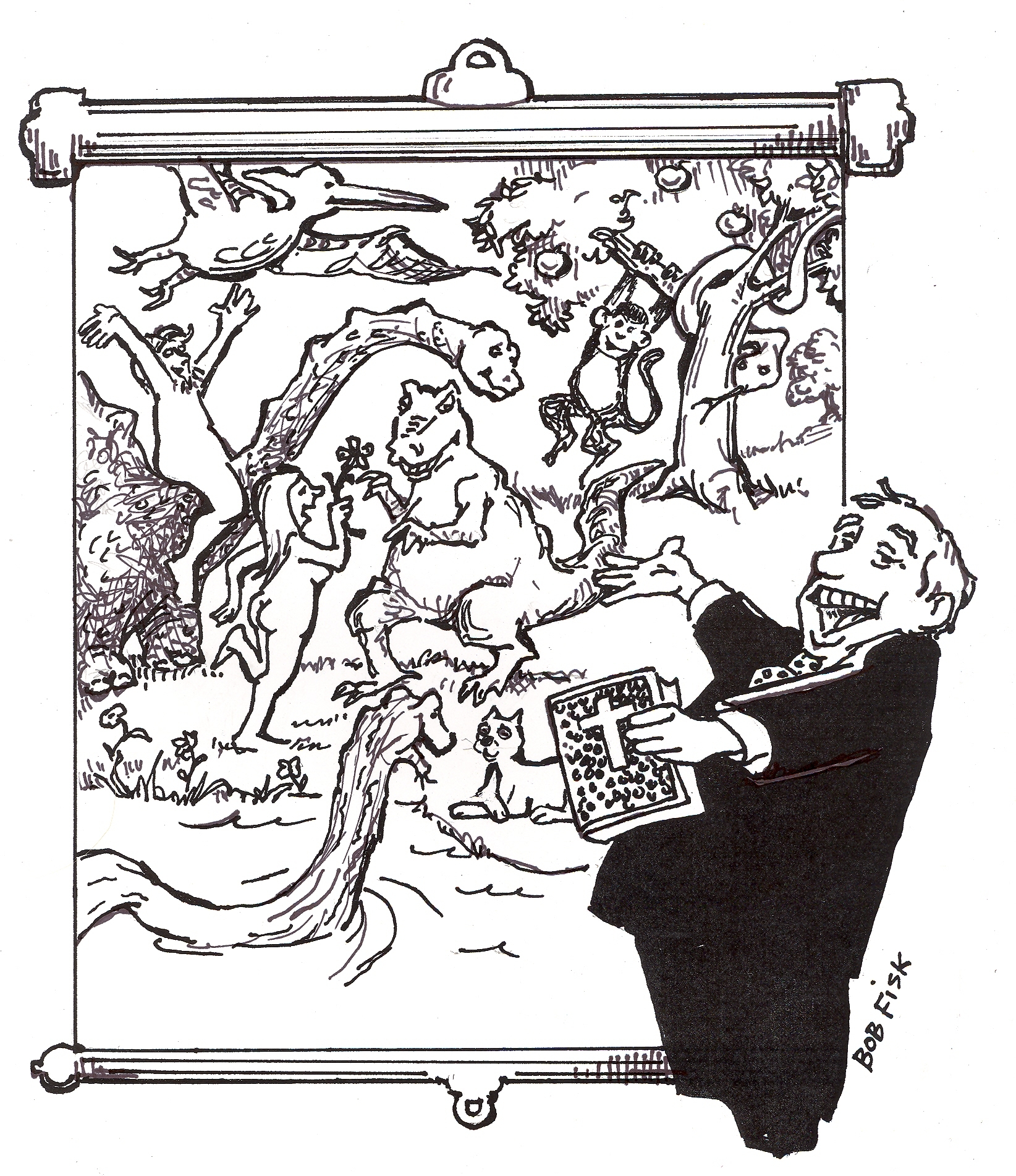
Creationist Fanatics
It's time to wag some savage tongue
At those who think the earth is young.
“Creationists” are what they're called
And frankly, you would be appalled
At what these yahoo dorks believe:
Apparently, they can't conceive
An age beyond six thousand years
For all the planetary spheres.
According to this witless herd
The Bible's the inerrant word
Of God Himself, and you had better
Believe it right down to the letter.
He made the earth and all we see
Around four-thousand-four B.C.
In one short week of frantic bustle
(God, you know, can really hustle).
The animals, the plants, and man
Came fully formed from God's own hand
Without the help of evolution.
Jerks in thrall to this delusion
Think fossils are an evil ruse
Placed by Satan to confuse
Mankind, and foster non-belief,
Thus leading to eternal grief.
Creationists say dinosaurs
Lived with cave men, and their roars
Could be heard on Noah's Ark,
And Eden was Jurassic Park
Where T. Rex and his monstrous ilk
Walked about as mild as milk.
Brontosaurus browsed the trees
With Eve and Adam at his knees,
And our first parents washed their dishes
In streams that held pre-Cambrian fishes,
For all was made at once, they croak:
God did it at a single stroke.
As for Darwin, these folks claim
He's now awash in penal flame,
And all who take his devilish path
Will join him in that fiery bath.
It really takes your breath away
That anyone with brains could say
We can ignore the age of rocks
That serve as stratigraphic clocks,
The speed of light, and isotopes
That prove (except to fundie dopes)
The earth's age is at least four billion
Of our years, give or take some million,
Or that these crackpots can deny
That simpler life forms live and die
And give rise, after countless ages,
To changed ones in successive stages.
This shows the human mind is liable
To rot when it assumes the Bible
Is a text of literal fact.
The truth is that the Bible's packed
With legends, myths, and allegories,
Fables and fictitious stories
Composed for a didactic purpose—
One can't believe them on the surface.
These yarns were spun to pierce the skull
Of shepherds, nomads, and the dull
Mentality of unschooled peasants
For whom myth was the living presence
Of Yahweh and His sacred word.
But now, it's mulishly absurd
To not admit these tales fantastic
Are just an arcane metaphrastic
Way of preaching to the masses
Who can't see things through reason's glasses.
This potpourri of Torah-tales
Is fictional, like Jonah's whale,
Or Joshua's trumpet, or the Flood,
The Red Sea parting, Abel's blood,
Sodomites made blind and halt,
A woman turning into salt,
Hagar saved by magic water,
Jephthah chopping up his daughter,
Manna dropping from the skies,
And all those other pious lies.
The scriptures tell us how to live
But don't presume they also give
Us scientific information
About the details of creation.
The Bible's sacred text was penned
To teach us of our final end;
It only speaks symbolically
Of how existence came to be.
So if you live in regions raw
Like Tennessee or Arkansas,
Rural Georgia, Texarkana,
The fever swamps of Alabama,
Or in the stretch of Geisterwelt
That Mencken called the Bible Belt,
Or in some mental dormitory
Where preachers howl for God and Glory,
Confine yourself to prayerful moan,
And leave the scientists alone.
Copyright © 2008 by Joseph S. Salemi
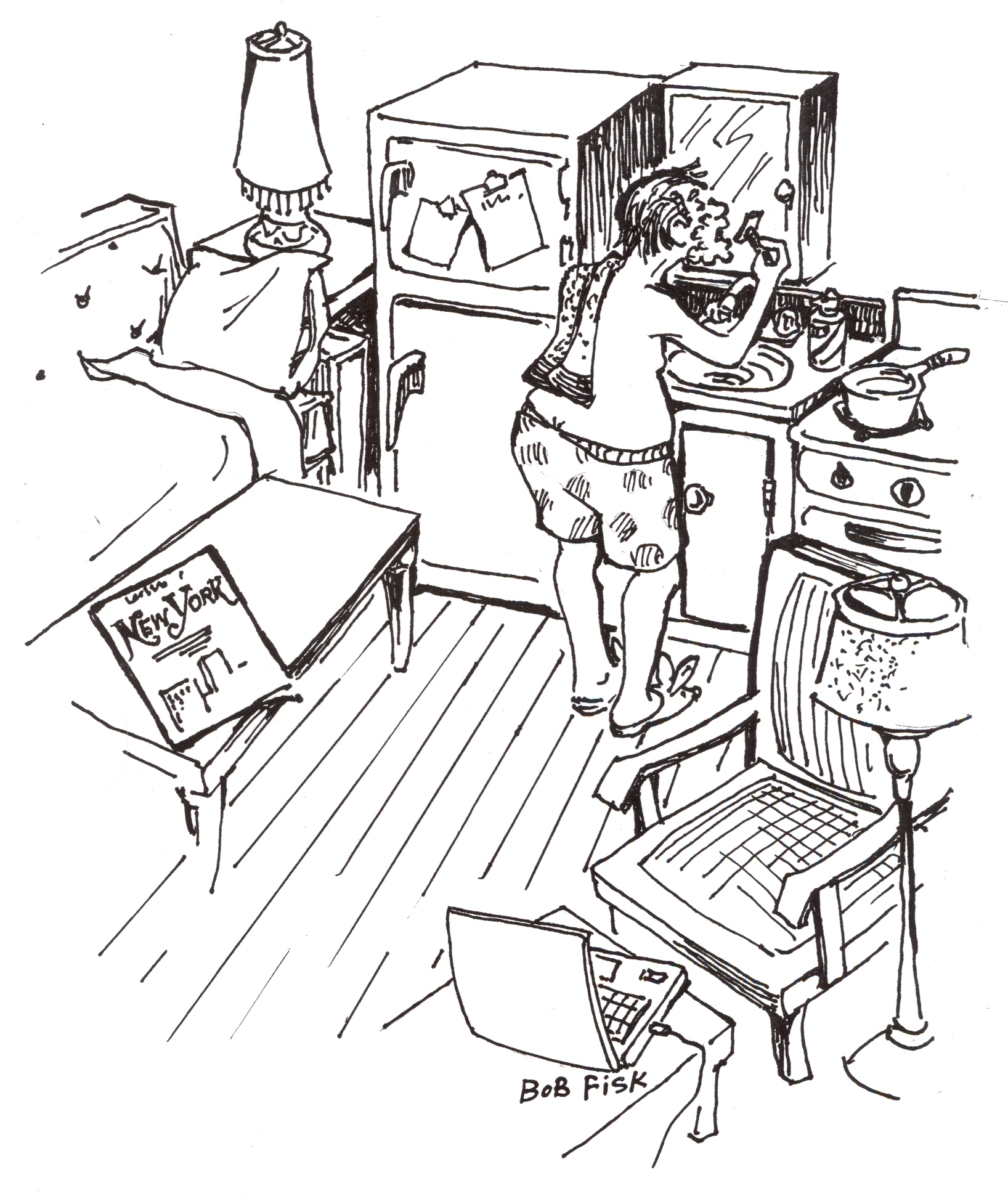
Living In Manhattan
A truly ethopathic need
Is that felt by the sicko breed
Of folks who love Manhattan's isle
And who insist it's worth their while
To pay a huge, outrageous rent
For lodgings where they're tightly pent
Up in a twelve-by-twelve-foot room
As cramped and stifling as a tomb.
These dorks live in a studio
That costs them the same monthly dough
You'd pay to get a hotel suite
Outside New York. What a treat,
To live inside a crummy box
Protected by six burglar locks;
To be confined in quarantine
Like sailors in a submarine;
To choke on your own sweaty stink
And take baths in your kitchen sink;
To sleep upon a sofa bed
With not enough room for your head
While using a refrigerator
That holds three eggs and one tomato.
And all because you love Manhattan
And look down on the Bronx and Staten
Island, Queens, and such-like spots
As places worse than empty lots.
You think the city's wild, vivacious,
Sexy, cool, and—goodness gracious!—
You wouldn't want to miss all that
By living in a Brooklyn
flat.
You long to be where things are “hot,”
Although you're just a little snot
Who lives inside a walk-in closet
On short-term lease and huge deposit.
The home you've chosen is a cage,
But still, suppressing grief and rage,
You smile and say you're quite content
With mini-space for maxi-rent.
And why? So
your return address
Can read “New York,
New York.”
I guess
You really are a bit retarded.
My prognosis?
Well, it's guarded—
Perhaps in twenty years or so
You'll find out you're a total schmo
Who could be living twice as nice
Some other place, for half the price.
Or else you'll stay put and expire
While watching rents go higher and higher.
But since you are an ethopath
You lack what is called Sinn und Rat
In German—that is, brains and sense,
And so you are at great expense
To subsidize your private cell
In chic Manhattan's
crowded hell.
My God, what a prodigious joke!
My best advice to you?
Go choke.
There's no prestige in mere locale—
Shall I say what you are?
I shall:
A pompous little arriviste
As common as a strain of yeast;
A small-town schmuck who glows with pride
Because he's on the posh West Side;
A cheap poseur who wants to chalk up
Points for his sleazy Soho
walk-up;
A two-bit dancer-waitress-whore
With loft space on an upper floor.
These are the slaves of New York City
Whose mindlessness deserves no pity.
Copyright © 2008 by Joseph S. Salemi
Child Worship
(from A Gallery of Ethopaths)
There's one way you can paralyze
This nation's brains—just vocalize
In wrenching sobs about some child:
Such rhetoric drives people wild.
Just open your capacious mouth
And scream out Children! north and south
And east and west and everywhere.
Fill up the circumambient air
With plaintive whining for “the kids.”
Redouble your outlandish bids
To keep them happy, safe, and well.
All other things can go to hell
As long as kids are divinized.
Why is it that these brats are prized
Beyond the bounds of common sense?
Why is this country one immense
Asylum on the subject of
The dictates of parental love?
When you say “children” (with due unction)
People's brains just cease to function.
They deliquesce into a pool
Of sugary, emotive drool
And rhapsodize about the joys
Of snot-nosed little girls and boys.
A plea for “children” overrides
All arguments, and then divides
The angels from their hellish foes,
And brings participants to blows.
Children! Children! screams the mob—
The word evokes a gut-felt throb
Reverberating through the land.
A primal fire's lit and fanned
Into a manic dance resembling
A D.T. drunkard's fits and trembling.
The mantra Children! carries clout
As potent as a studded knout.
It trumps all logic and debate
And stirs up righteous, holy hate
Against those evil few who might
Suggest that children aren't quite
A herd of consecrated cows
To which we have to make our bows.
It's not ethopathy per se
To worship children in this way
But shows a mind that's out of kilter,
Unable to discern or filter
Fact from fancy, truth from dream.
What sense is it to howl and scream
And go into a frenzied state
Protesting against human fate?
For that is what parental clods
Do, who turn their kids to gods.
No child can ever be eternal—
He's just the little seed or kernel
Of something greater in the works.
You hyper-sentimental jerks
Who've energized this witless craze
To shower kids with unearned praise
Should dwell on this: it's only years
That generate such hopes and fears—
No single child that's now alive
Can stay that way. Should he survive
Beyond his adolescent stage
He moves inexorably towards age.
A decade and a half will pass
And he will be a standard ass
No different from the rest of us,
And not the focus of such fuss.
So listen up—I've got some words
For all you lachrymosal birds
Who've rendered infantile the arts,
Anesthetized our brains and hearts;
Who've filled the world with clowns, buffoons,
And puerile games and daft cartoons;
Who've turned our schools into a hell
Of babysitting show-and-tell;
Who've dropped the country's mean IQ
To something under 82;
Who've spoiled and pampered kids until
There's dry-rot in their minds and will;
Who've Disneyfied the whole damned nation
To please the pre-teen generation:
Attention, brain-dead soccer moms
Flailing grim, protective arms,
Attention, stolid, oafish dads
Who worship little girls and lads,
Your children aren't minor gods
Who've sprouted from your groins and cods.
They're just replacements in the war
We fight with time, and nothing more.
So cease the flapping of your jaws—
Stop passing sick, draconian laws
That privilege children beyond measure.
Remember that a child's a treasure
Only if he soon grows up
And drinks adulthood's bitter cup.
There's one thing children really need:
To learn that life will make them bleed.
It's cruel and vicious to prolong
Their thoughtless days of play and song.
Copyright © 2008 by Joseph S. Salemi
Genesis
Way back in the Jurassic, when the reptiles ruled the earth,
All living creatures gave Tyrannosaurus Rex wide berth;
His jaws and his incisors were decisive in a fight—
No other being could survive his devastating bite.
This T. Rex was a nightmare from the deepest pit of hell;
His rule was total, absolute, and mercilessly fell.
He tore, he ripped, he slashed, he rent; his steps made terra quake,
And when he roared his savage voice caused everyone to shake.
And yet around his monstrous feet, imbrued with blood and gore,
There scurried little creatures that I doubt he even saw.
Or if he noticed, these small things occasionally served
To give Tyrannosaurus Rex a sampling of hors d’oeuvres.
These creatures were the mammals, an obscure and minor breed:
Warm-blooded little vertebrates whose infant young would feed
On milk from teats—a novelty in that egg-bearing time,
When almost everything was hatched in clutches or in slime.
And so it went for eons, and it never would have changed—
Tyrannosaurus ruled the roost; the mammals never ranged
Much wider than the forest floor, where they could always hide
In underbrush and foliage, and hope they’d not be spied.
Until one day an asteroid from some far distant source
Came crashing down into the earth with such stupendous force
It pulverized whole mountains, it evaporated seas;
It detonated with a heat unmeasured in degrees.
It generated tidal waves, and triggered seismic shocks—
It scorched the world with fire and it melted solid rocks.
It sent up in the atmosphere a cloud of cosmic dust
So choking and so toxic that the dinosaurs went bust.
The sun was blocked for years and years; the temperature soon dropped,
And reptiles with their stone-cold blood stood motionless and stopped.
Tyrannosaurus couldn’t cope, and transformed into coal,
And all the other mega-beasts soon sank in the same hole.
When all was calm, who had survived? The mammals, to be sure—
They managed to get through the blast, to hang on and endure;
There wasn’t any T. Rex now to cause dismay and fuss,
And so they leisurely evolved into the thing called us.
The HyperTexts